
History Major. Cripple. Vaguely Left-Wing. In pain and constantly irritable.

  • 606 Posts
  • 290 Comments
Joined 1 year ago
cake
Cake day: March 24th, 2025

help-circle


  • After several angry thrusts on either side, the point of Mattheson’s sword actually touched his adversary’s breast, but, fortunately, was turned aside by a large metal button which Handel wore on his coat. The consciousness of how narrowly he had missed injuring, if not actually killing, his friend brought Mattheson suddenly to his senses, and, the bystanders at this juncture interposing between them, the duellists shook hands, and thenceforth, it is said, became better friends than ever.

    A life and a friendship saved by a button.


  • They were fairly effective. The two big advantages were range when using larger projectiles, and ease of use - an ordinary sling takes a lot of training to truly master.

    On the other hand, they lacked precision/accuracy and speed compared to ordinary slings.

    Staff slings actually lasted a bit longer in military usage than ordinary slings because they can throw much heavier projectiles, but that’s a double-edged sword (ha) - projectiles are something that have to be carried on the march. So they remained mostly in specialist applications, like naval and (defensive) siege warfare, where stores of ammunition didn’t have to be carried by hand or pack animal, and in regional contexts (like Spain).


  • Finally, a walkable city!

    The forums were perfectly walkable as-is! 😭

    Funny enough, animal-drawn transports and mounts were banned in the city of Rome, except for actual cargo. NO PASSENGER SERVICE ALLOWED

    Also interestingly, Roman architectural texts discuss how to lay out a city for pleasant walking, as it was considered both necessary (most people walking even in cities that didn’t ban animal-drawn transports) and healthy! Trees along streets were considered important for beauty, shade, wind cover, and a vague (if true!) sense of natural health.

    What do we know about how common people were living through these crumbles of the empire? Do you have any interesting sources?

    Unfortunately, most of the sources I’ve read focus on the immediate aftermath of the fall of the Empire, before the cities really got ‘re-inhabited’ like in the above transition. I do know that in the medieval period cattle were grazed through many parts of the city of Rome, since the original boundaries far outstripped the population of the medieval period (less than 10% of the population at the city’s Classical-era peak!).


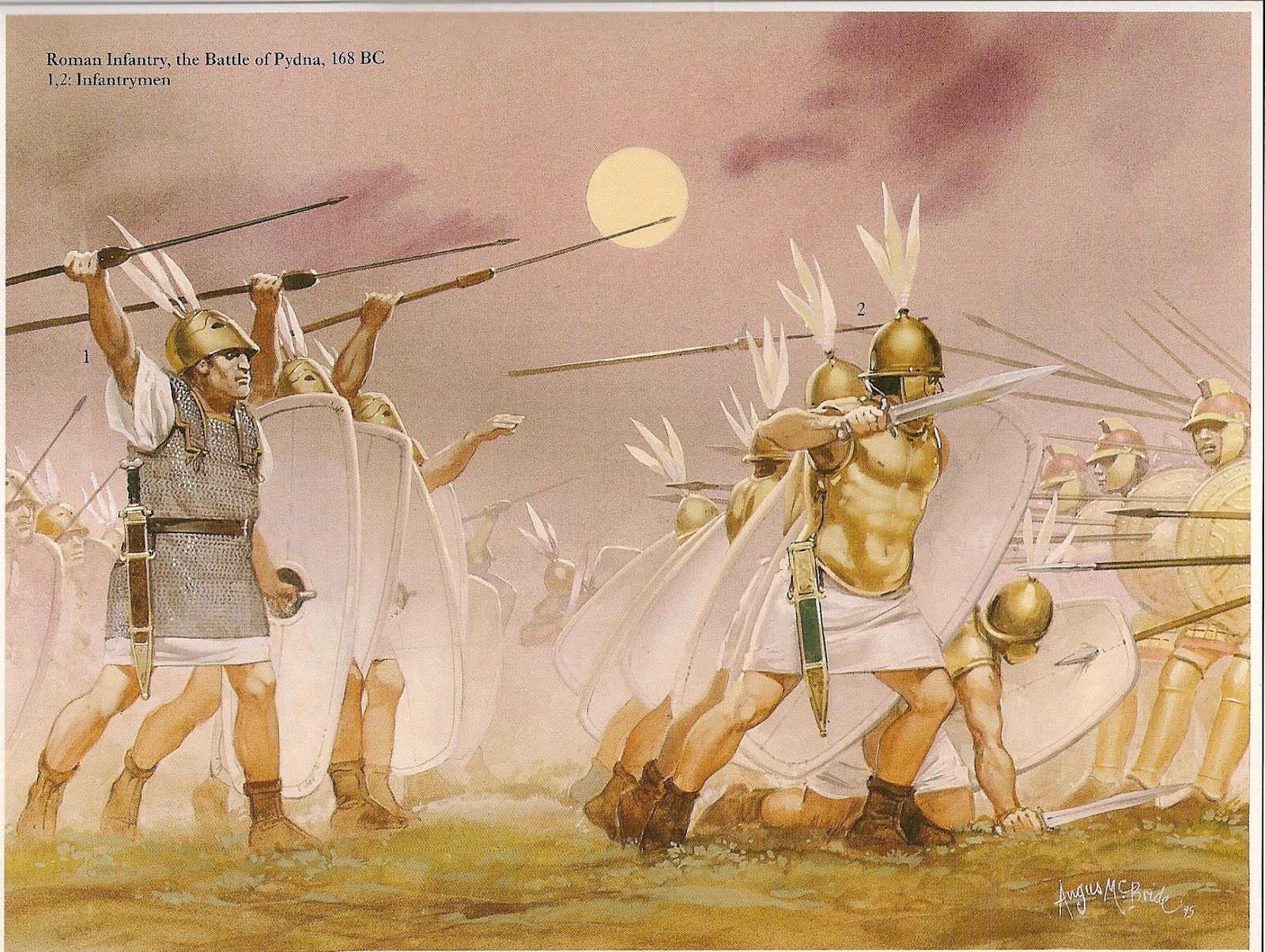
  • There appears (unless there’s something specific here I’m missing, which is very possible - even on Rome, my favorite obsession, what I don’t know fills libraries!) to be a minor mistake in this drawing, funny enough - a legionary’s scabbard in this period should be on his right side. Only officers wore their swords on the left.

    While this is unusual in European swordsmanship in general, the Roman Legions of the Mid-Late Republic and Principate era of the Empire preferred it because it kept the shield-hand unimpeded when drawing the sword, especially when in close-order formation. The current two ways of thinking are that it was drawn with a reverse grip, and then shifted to the correct, forward-pointing position (fast, but potential for clumsy fingers is high); or that the scabbard itself was worn somewhat loosely (and the gladius was short enough) so that the scabbard could be pointed forward, and then the blade be pulled out in a ready-to-strike position (useful, but reliant on very good proportions between sword length, belt length, arm length, and, well, soldier length).

    2nd-3rd century AD is suggested by the helmet (note the ridge over the forehead - uparmored helmets like that were only popular in the 2nd-3rd century) and wearing of trousers (while trousers were worn on the Germanic frontier as early as the 1st century AD, they didn’t become widespread until the 2nd). The distinctive body armor, the lorica segmentata, was only in use from the 1st-3rd centuries AD, with a smattering of suspected remnants in the 4th century AD.