

9·
14 天前You should check out Scavenger’s Reign! The intro music only becomes more haunting and fitting as you learn more about the story. I never skipped it and i typically don’t like title sequences
Edit: Intro link
You should check out Scavenger’s Reign! The intro music only becomes more haunting and fitting as you learn more about the story. I never skipped it and i typically don’t like title sequences
Edit: Intro link

Octavia Butler has an essay that makes the same key point as Stephen King: read and write. It’s the same as any other skill. If you’re a musician, you listen to music and play your instrument. If you want to draw, you watch people draw, observe their process, and you draw. If you’re a welder, you watch people weld, study the process, and you weld.
Storytelling, however, is very broad. You see it on tv, in movies, in books, and you practice in daily conversation. There are loads of books and videos discussing different aspects of storytelling structure, form, and best practices. The Great Courses even has a lecture series on storytelling. But the best thing you can do is read and write. And ask for feedback.

Oh man, I wonder what the author of The Book of Eels thinks. I remember thoroughly enjoying the book even though it ended without any conclusive idea where eels come from


And a couple that aren’t really reactions but I use them anyway:


When they announced new star wars like 10 years ago I really hoped for a Kyle Katarn story. Seeing what they’ve done though I’m glad they left him alone
Catching strays
Watch videos and read some articles about it. There are different edge angles for different use cases, but you’ll generally aim for 20-25°. For things like razors and kitchen knives you’ll want a straight grind/edge and for more heavy use knives a slightly beveled edge is okay. Low grit is for large corrections like burrs and blunt spots. Those kinds of corrections will take a lot of time and you’ll want to look for uniformity before moving to higher grits for a sharper edge and eventually polish. Highly recommend starting with an angle tool and going slowly with a knife you don’t really care about. Work on keeping your angle and pressure consistent and don’t press down very hard. If you apply too much pressure you’ll damage both the edge and stone, especially for softer (higher grit) stones. Check your work regularly to make sure the edge is consistent, you’ll see it pretty clearly under a light. It takes practice. I’ve been freehand sharpening for about 20 years and I still mess up sometimes.
My biggest tip is regular maintenance! I clean and do a few passes on 3000 grit with my kitchen knife every time I use it and it’s been my sharpest knife for 10 years. And clean your stone! Residual steel will build up, making the stone less effective and also risking damage to the edge.

By sheer coincidence, I just made an install image yesterday and will be switching soon

There’s some debate on this! Most movie dialogue is designed to convey the impression of conversation, but this is naturally unrealistic. People stutter and start over and get distracted in normal conversation much like you described, which can become very burdensome on the screen. Like when your boss won’t get to the point in the standup. Overly precise dialogue is equally burdensome and often fails to maintain attention (see: the Time 1776 AI videos). A lot of the discussion around how best to balance those natural pauses and disruptions around the otherwise “eloquent” speech in movies to best convey a characterization.
I’m sure others out there can point to legitimate sources, but I’m not super read up on it

Ice chains for traction. It might be a type of crampon, I’m not certain what the distinction is.

Well I just dumped windows and MS office. For machine vision I’m only dabbling with openCV, so that’s already open source. The switch to libre office has been pretty nice though
Pulse Water Modulation
Cool thanks, I’ll stick with it! At least until I’m familiar and want to try something new
No worries, it’s all part of the experience
Hmm, okay. Yeah I was trying to set up an environment to dabble with machine vision and had trouble finding good instructions or guidance for programming env setup. I think in college we used something-Unix but it’s been so long I don’t really have a frame of reference anymore. So I’m looking for a low-overhead daily driver that’s also relatively common or amenable to maker communities
If that makes sense.
Damnit I just switched to Ubuntu. That explains why I kept getting lost. What about Debian?
Great book, I need to listen to it again. But the interview will do for now!
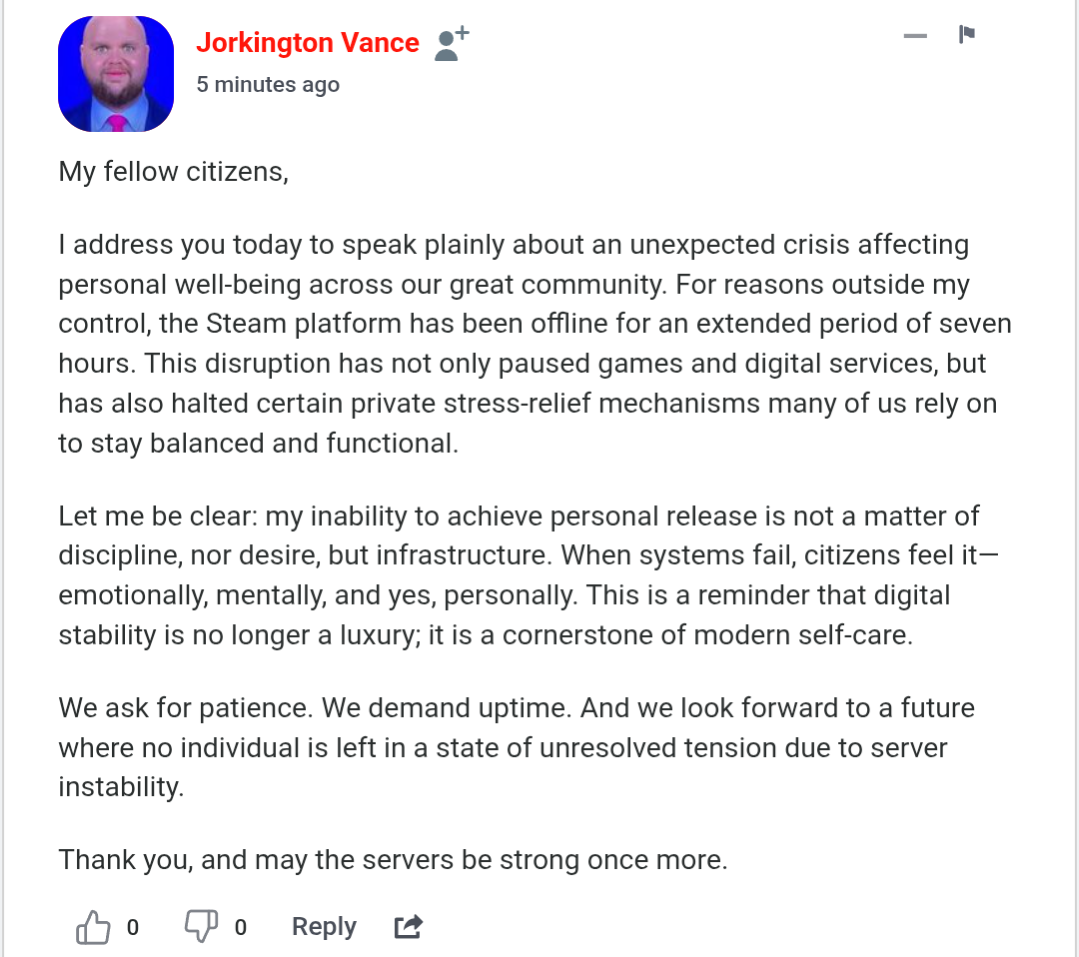
The downdetector comments have descended immediately into utter madness


Oh yeah, 100%! It also lands a little differently through the show, sometimes despairing, sometimes regretful, and even with a flicker of hope. Absolutely recommend if you’d like a sci-fi survival story that feels like a dark graphic novel. The writing is top notch