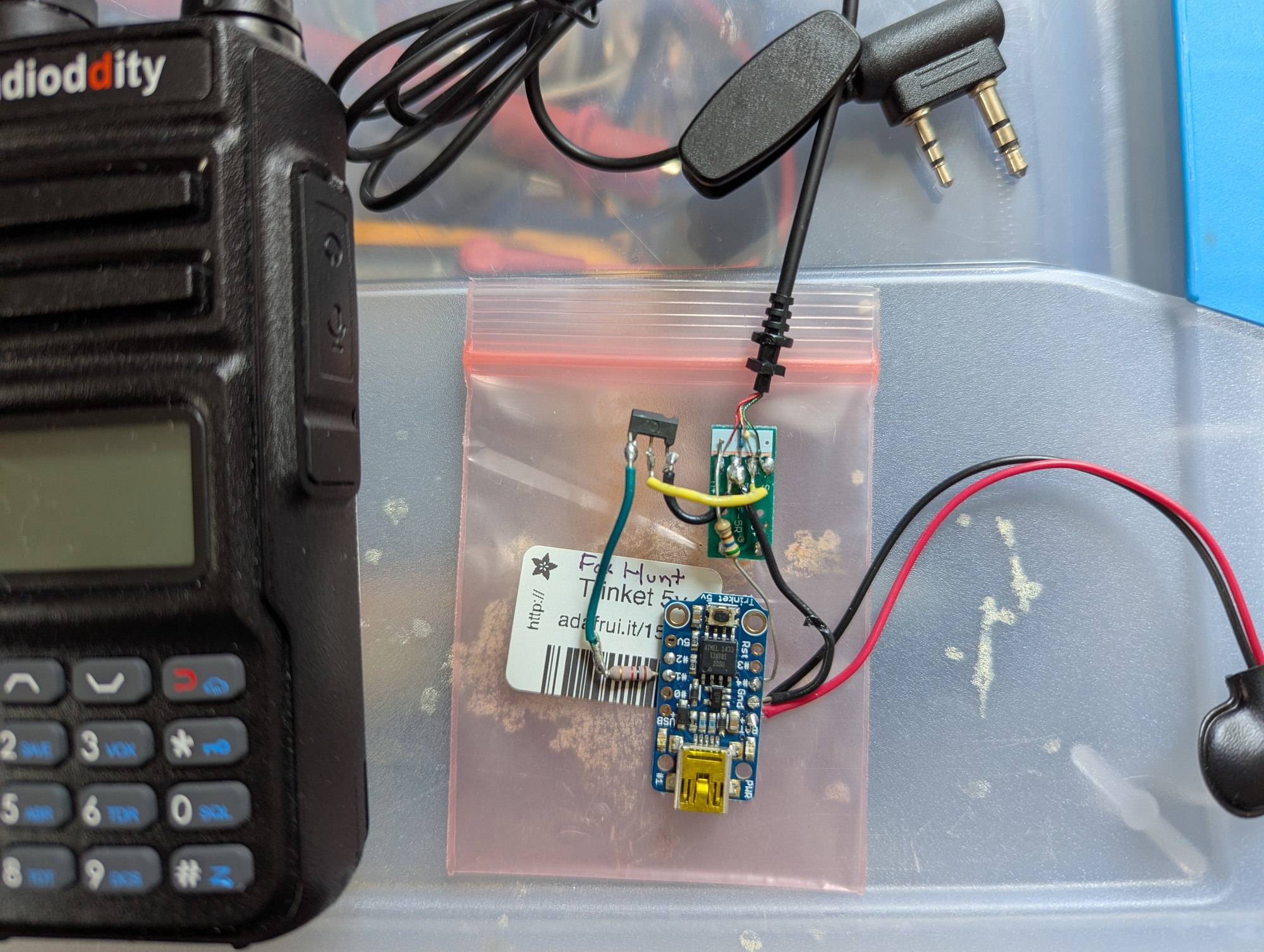
There are lots of fox hunt guides so I won’t repeat all the details. But A few that weren’t obvious or I did differently:
- I used the earpiece from my Radioddity GMRS radio. By popping open the mic/button on the cord, I was able to solder onto conveniently labeled pads rather than having to separate out the wires. M+ = mic input, S+/- for the speaker includes S- as ground, PT needs to be grounded for PTT.
- I used an NPN transistor (1kohm resistor on the base) to connect PTT (connected to the collector) to S- aka ground (connected to the emitter). Most guides say to use a relay, but even though this still showed 26 ohms or so resistance when open, it works fine to trigger transmission.
- I used an old Trinket 5V I had lying around, since it has a wide battery voltage input (5-16v I think, accepts a 9v battery fine). However it uses an ATtiny85, which the Arduino
tone()function doesn’t support. I ended up using http://www.technoblogy.com/show?20MO to generate the tone, and then wrote some very simple / non-general Morse generation code (glad to share the full sketch if anyone’s interested). - A 560ohm resistor from the 5v DO pin on the Arduino worked fine to drive the line in. And I didn’t have to remove the existing mic element. I was unsure what voltage range I was going for on line in.
Next step is antennas, and setting up in some enclosure with a HAM HT instead of the GMRS radio I was testing it with. I found a variety of antenna guides, but glad for other/better resources:
- simple wooden one
- lots of details, PVC boom
- also lots of details, PVC boom
I would like to find a calculator for the dimensions based on frequency so I could potentially make a directional antenna for GMRS too.
For other people seeing this from All: https://en.wikipedia.org/wiki/Amateur_radio_direction_finding
Oh, that is cool! I’d probably go for something more fancy, but hey, it does the job.
For antennas, Id probably go with wood or aluminium (depending on what is on hand) and brass tubes from the hardware store. If you want it to be small, a HB9CV (“phased 2 element yagi-uda”) is pretty easy, too, and has better directivity than a Yagi of the same size
Thanks! The HB9CV looks fun.