

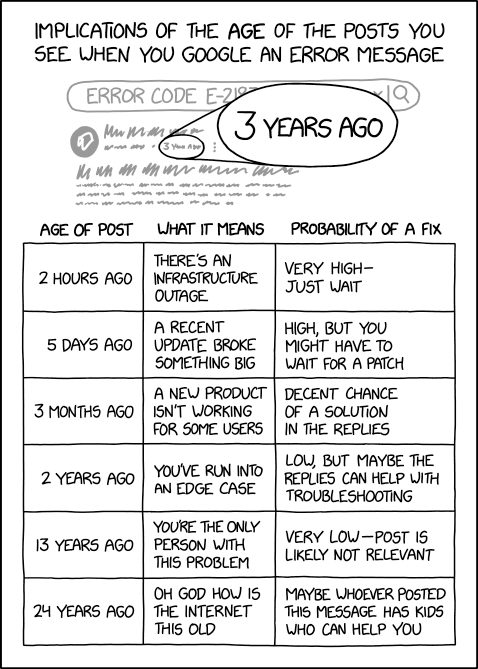
Title text:
Please, we need your help. Our research suggests you’re the last living descendant of the person who knew how to format this config file.
Transcript:
Transcript will show once it’s been added to explainxkcd.com
Source: https://xkcd.com/3245/
Sorry, what is telnet? Never heard of it, but this all interests me.
Telnet is basically the predecessor to SSH for terminal-over-network communications:
At this point, it is archaic network technology:
It was developed in a time when only very specific organizations with lots of funding had access to computer networking. The Mother of All Demos had happened only the year prior. The first version of the Internet Protocol used today would not come until 1973.
There was no concern that unauthorized parties might eavesdrop on the communications between networked computers. Also, at this time there were no functional computer networks that extended beyond local sites. The first ARPANET nodes would not start communicating with each other until 1970:
There weren’t interstate or international network connections, or public routing architecture or DNS or anything like that.
So basically, everyone who could possibly access your computer network would have to be on site, and probably in the room with the (very classified) government research computers. At this point you could count the number of people who really understood computer networking technology (globally) on your fingers and toes. If you happened to be working in this field, you could probably name offhand all of the people who understood enough about the technology that could possibly pull off a vulnerability exploit against Telnet, and you very likely knew them personally. Cybersecurity wasn’t a thing that anyone was worrying about yet.
All of the security features that have been added to Telnet are afterthoughts, bolted on to the original system. It was never designed for the public Internet that we have today. And yet… there is still legacy technology out there that uses Telnet for remote access and administration, some of it in critical infrastructure like power grids and water systems.
Ultimately, my point is that it’s very very difficult to eliminate communications technologies once any kind of industrial, commercial or government activity starts to use them for regular business. It’s one of Microsoft’s biggest problems with the products that they have been selling to various enterprises since the 90s (Windows Desktop, Windows Server, Active Directory, Word, Excel, etc) - they’re forced to maintain compatibility with legacy stuff even when they know without a doubt that it creates major security problems, because there are too many organizations dependent on that software. The Internet is like this now, and the people who were part of its foundation are dying off.