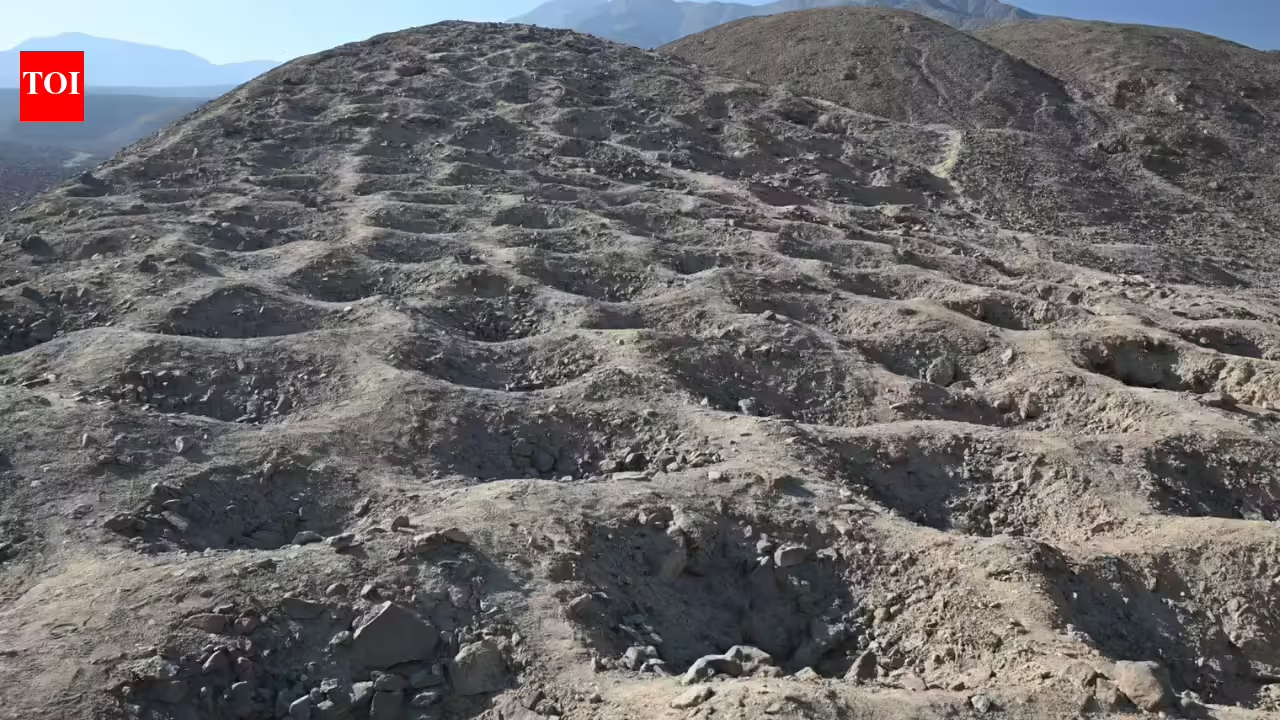
For nearly a century, thousands of strange holes carved into a barren Peruvian hillside puzzled archaeologists, historians, and even conspiracy theorists.
Its just a barrier. Humans have been digging these structures for thousands of years all over the world. Its a lot easier and quicker to just dig a bunch of closely packed holes than it is to build a structurally sound wall. Neither will stop people so the goal is to slow them down.
“Researchers noticed that the pits were arranged in repeating numerical patterns and grouped into sections, suggesting a deliberate organisational system rather than random digging.”
“Band of Holes may have operated like an enormous outdoor spreadsheet or inventory system.”
I did. Read my comment. I never said they were randomly dug, its very well documented that pit barriers are dug in specific patterns to minimize the navigable terrain.
Scientists analysed sediments collected from several pits and discovered traces of maize pollen, plant fibres, reeds, and organic material associated with human storage and transport activities.The maize evidence was especially important because maize pollen does not naturally spread far through the wind in large quantities. Researchers say this strongly suggests crops or goods were intentionally placed inside the holes.The discovery supports the idea that the pits were connected to trade, storage, or taxation activities rather than ceremonial use.
All we really know is that someone(s) dug holes in a pattern, and possibly stored some maize and other materials in those holes.
It’s even possible that the storage purpose was way after the holes were created. What if at first they were made to slow down the enemy, then both people fighting in the area left, someone else came, saw some cool holes in a pattern and was like “awesome, we got this shitton of corn and reeds and whatnot, these holes will be perfect to store them in!”, and bam, now scientists are correlating the two because of the evidence being somewhat blurred.
A lot of archaeology is coming up with wild ideas supported by often very limited facts, and looking at other relevant sources that may or may not support the theory. This is especially true for sites that have little to no written confirmation of the purpose.
"Alot of archaeology is coming up with wild ideas supported by often very limited facts, and looking at other relevant sources that may or may not support the theory.
Yet that is exactly what you are doing by suggesting a discredited idea.
“But no evidence of strife—much less an adjacent settlement to defend—has been found at Monte Sierpe.”
Ah, the link you’ve added AFTER my comment. Because nothing screams more fairness in a debate than going back and modifying your argument.
Also, the very article you quote does the polar opposite of what you claim. It does not discredit but actually support my “armchair archaeologist” theory (which wasn’t even a theory, just an example of how things COULD be misappropriated due to archaeological evidence generally being scarce):
Their results have established that Monte Sierpe wasn’t actually the handiwork of the Inca, but of an entirely different kingdom that controlled the area before they arrived. The researchers believe the rulers of this kingdom designed the Band of Holes to serve a purpose that was vital to their success and that the Inca later expropriated it for use as a tribute depot.
Arguably I’ve only gotten haflway through the article as it’s 2:30am here, but that very statement seems to suggest that said “discrediting” didn’t really happen.
No, scientific method says we collect evidence, then try to find reason, get to some conclusion. Yes, it’s an educated guess, but based on some evidence. Unlike your bullshitting: “I think that in my armchair 5000 km away, I must be right, and the archeologists on site are wrong”
Educated guess, based on very little evidence. Just like the above linked article where they found some broken bowl pieces, determined that the pieces are ~500 years old, thus the holes must be too… Only to be proven otherwise just a few years later because apparently considering the fact that maybe the bowls got there AFTER the holes were dug, is an outlandish idea.
Besides, my bullshitting was a theoretical example focusing not on being right, but showing how archaeologists can be wrong by assuming things that are very loosely supported by evidence. But that clearly went above both your heads…


Its just a barrier. Humans have been digging these structures for thousands of years all over the world. Its a lot easier and quicker to just dig a bunch of closely packed holes than it is to build a structurally sound wall. Neither will stop people so the goal is to slow them down.
Read the article.
“Researchers noticed that the pits were arranged in repeating numerical patterns and grouped into sections, suggesting a deliberate organisational system rather than random digging.”
“Band of Holes may have operated like an enormous outdoor spreadsheet or inventory system.”
I did. Read my comment. I never said they were randomly dug, its very well documented that pit barriers are dug in specific patterns to minimize the navigable terrain.
Eh, it’s still just wild guesses.
All we really know is that someone(s) dug holes in a pattern, and possibly stored some maize and other materials in those holes.
It’s even possible that the storage purpose was way after the holes were created. What if at first they were made to slow down the enemy, then both people fighting in the area left, someone else came, saw some cool holes in a pattern and was like “awesome, we got this shitton of corn and reeds and whatnot, these holes will be perfect to store them in!”, and bam, now scientists are correlating the two because of the evidence being somewhat blurred.
A lot of archaeology is coming up with wild ideas supported by often very limited facts, and looking at other relevant sources that may or may not support the theory. This is especially true for sites that have little to no written confirmation of the purpose.
Yet that is exactly what you are doing by suggesting a discredited idea.
“But no evidence of strife—much less an adjacent settlement to defend—has been found at Monte Sierpe.”
https://archaeology.org/issues/march-april-2026/features/return-to-serpent-mountain/
And aside from pulling it out of your arse, where did you get the “discredited” part from?
For all the downvoters: genius above only linked the article after I called them out. Take my comment as if there was no link.
I linked to the archaelogy.org article that discredited it with the relevent quote.
Ah, the link you’ve added AFTER my comment. Because nothing screams more fairness in a debate than going back and modifying your argument.
Also, the very article you quote does the polar opposite of what you claim. It does not discredit but actually support my “armchair archaeologist” theory (which wasn’t even a theory, just an example of how things COULD be misappropriated due to archaeological evidence generally being scarce):
Arguably I’ve only gotten haflway through the article as it’s 2:30am here, but that very statement seems to suggest that said “discrediting” didn’t really happen.
No, scientific method says we collect evidence, then try to find reason, get to some conclusion. Yes, it’s an educated guess, but based on some evidence. Unlike your bullshitting: “I think that in my armchair 5000 km away, I must be right, and the archeologists on site are wrong”
Educated guess, based on very little evidence. Just like the above linked article where they found some broken bowl pieces, determined that the pieces are ~500 years old, thus the holes must be too… Only to be proven otherwise just a few years later because apparently considering the fact that maybe the bowls got there AFTER the holes were dug, is an outlandish idea.
Besides, my bullshitting was a theoretical example focusing not on being right, but showing how archaeologists can be wrong by assuming things that are very loosely supported by evidence. But that clearly went above both your heads…